Fall 2020 interdisciplinary education for maximum engagement: If not now, when?
A justification for interdisciplinary learning during Covid
- Supports most recent research and best practices in Design Thinking/UbD/PBL and 21st C Skills
- Structure ensures that students are not overwhelmed by too much communication from multiple unsynchornized courses
- Content is cumulative, interdisciplinary and requires participation for success
- Participation is ensured by students choosing topics that interest them and engaging in self-directed research within essential foundational concepts
- F2F Hybrid interdisciplinary classroom units can switch between online delivery and F2F blended delivery
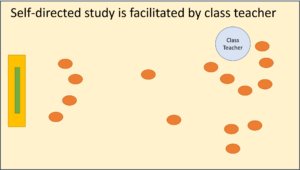
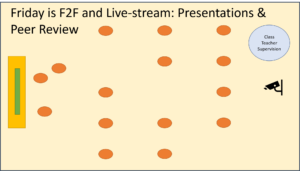
- F2F mode allows students to move freely within their classroom and associate with peers which supports socialization crucial to this age-group
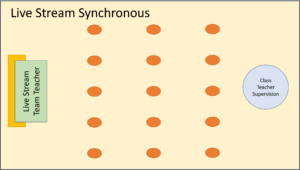
- Each class watches live synchronous content from 3 other interdisciplinary unit teachers
- If anyone in a class becomes sick, then the entire class moves online and quarantines
- Two weeks between units ensure that entire school is healthy for next unit
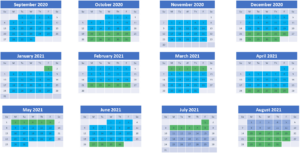
Interdisciplinary, hybrid, and synchronized education calendar – 7 week interdisciplinary unit, 2 week gap between each unit
Interdisciplinary hybrid cohort structure
- 60 students per interdisciplinary cohort/unit
- 15 students per classroom group
- 4 classroom groups per interdisciplinary unit
- 4 Teachers per interdisciplinary unit
- Students stay in one group for 7 weeks interdisciplinary unit
- Each classroom group stays in separate classrooms when F2F
- Two weeks between units ensure that entire school is healthy for next unit
- Evaluation in interdisciplinary is continuous and characterized by ongoing feedback
- Two weeks provides time for teacher evaluation and preparation
- 4 days for evaluation of unit and administrative issues
- 4 days break
- 4 days for unit prep
- Arts requirements can be fulfilled flexibly throughout unit
- Consider hiring local artists to teach community-based art education
Interdisciplinary daily and weekly classroom timeline – F2F, Hybrid, or fully online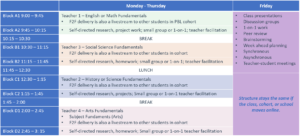
Interdisciplinary Design Thinking/Ubd/PBL team, and possible themes
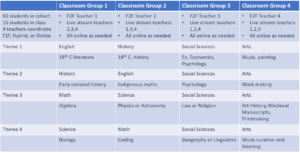
What does the classroom look like?

Arguments against it?
- Teachers haven’t been trained to engage in project-based learning and delivery
- Things will go wrong because it’s a new model
- Assessment structure will have to be adapted
- Not enough time to prepare
Final thoughts
Whatever happens in the Fall of 2020 is going to be a trial run at best. Change is upon us, and I suggest we embrace every aspect of it. Design Thinking/PBL/UbD is the most engaging learning structure available to humans because it reflects our lived experiences. Research has shown that our current educational models do not reflect the real world of work, nor the skills that are needed in the 21st century. There is arguably nothing good about Covid19, and how it has ripped through the global community at every level. But, it would be a shame not to reach for the opportunities for change that Covid presents. It is time to think out-of-the-box, even if we’re stuck inside them for the foreseeable future.
Discuss!
The only way to get to the best right solution is to hammer it out. This piece was meant to begin a conversation.
Sources
Cobo, C. (2013). Skills for innovation: Envisioning an education that prepares for the changing world. Curriculum Journal, 24(1), 67-85. doi:10.1080/09585176.2012.74
Carleton University Scenario Planning (CUSP) Working Group, 2020). Planning for Fall 2020. Carleton University. Retrieved from https://carleton.ca/provost/cat/reports/
Gonser, S. (2020). Using project-based learning to prepare students for cutting edge careers. Edutopia; George Lucas Educational Foundation. Retrieved from https://www.edutopia.org/article/using-project-based-learning-prepare-students-cutting-edge-careers
Fullan, M. and Donnelly, K. (2013). Alive in the swamp: Assessing digital innovations in education. London, UK: Nesta. Retrieved from https://www.nesta.org.uk/sites/default/files/alive_in_the_swamp.pdf
Marshall, J. (2014). Transdisciplinarity and art integration: Toward a new understanding of art-based learning across the curriculum. Studies in Art Education, 55(2), 104-117.
McIntosh, E. (2018). What’s the difference between PBL and design thinking. Toronto, ON: NoTosh Inc. Retrieved from, https://medium.com/notosh/whats-the-difference-between-pbl-and-design-thinking-32ea04c46116
Northern, S ((2018). Phenomeno-based learning in Finland inspires student inquiry. Education Week. Retrieved from https://blogs.edweek.org/edweek/global_learning/2018/10/phenomenon-based_learning_in_finland_inspires_inquiry.html
Ottawa-Carleton District School Board, (2020). Learn at Home and p lanning forward survey. Retrieved from https://ocdsb.ca/our_schools/novel_coronavirus_information_for_parents/learn_at_home/learn_at_home_and_planning_forward_survey
Ontario Ministry Of Education (2016). 21st century competencies: Foundation document for discussion. Toronto, ON: Queens Printer for Ontario. Retrieved from http://www.edugains.ca/resources21CL/About21stCentury/21CL_21stCenturyCompetencies.pdf
People for Education (2020). The New Basics. Retrieved from https://peopleforeducation.ca/measuring-what-matters/
People for Education (2020). From measuring what matters to the new basics. Retrieved from https://peopleforeducation.ca/measuring-what-matters/
Upitis, R. (2011). What works: Research into practice: Engaging students through the arts. Toronto, ON: Queens Printer for Ontario. Retrieved from http://www.edu.gov.on.ca/eng/literacynumeracy/inspire/research/WW_Engaging_ Arts.pdf
Voogt, J., Erstad, O., Dede, C. & Mishra, P., (2013). Challenges to learning and schooling in the digital networked world of the 21st century. Journal of Computer Assisted Learning, 29, 403-4013. https://www.edugains.ca/newsite/21stCenturyLearning/about_learning_in_ontario.html

